Future Self: how it sounds
How Future Self is built: layered binaural beats from 4.25 to 40 Hz on carriers from 122 to 612 Hz, session by session, with the research behind the method and an honest summary of the evidence.
How this course sounds — the science
Every session is a layered binaural program: several tone pairs, one tone of each pair per ear, over a soft noise bed. The numbers below come straight from the session designs.
The course in numbers
- Beats from 4.25 to 40 Hz, covering the theta, alpha, beta, gamma bands.
- Carrier tones from 122 to 612 Hz.
- Up to 4 tone pairs sound at once.
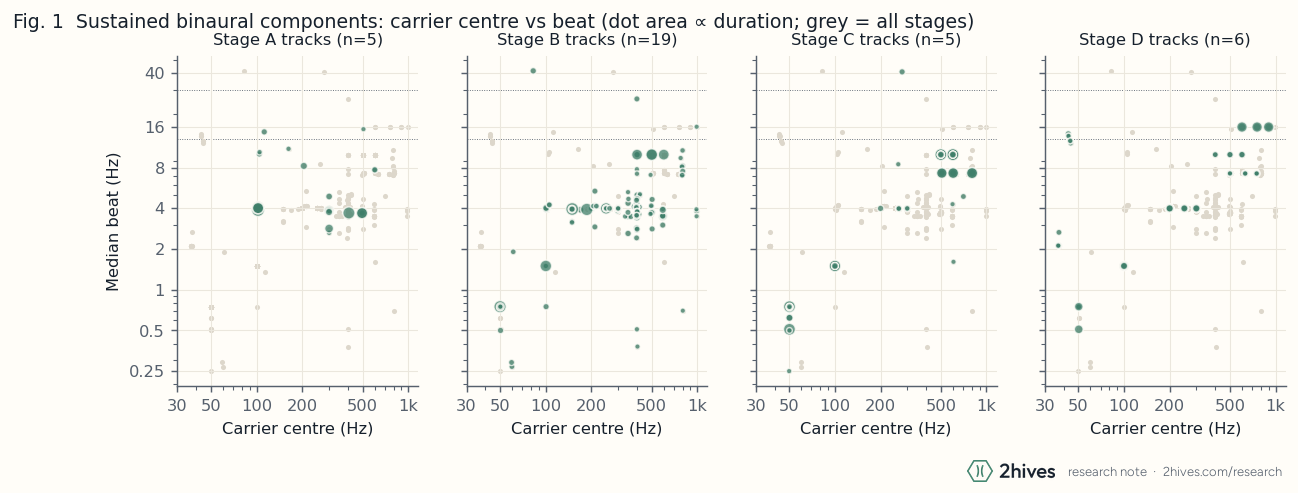
- Slower beats sit on lower carriers in 74 of 102 pair comparisons, the ordering measured in the reference set.
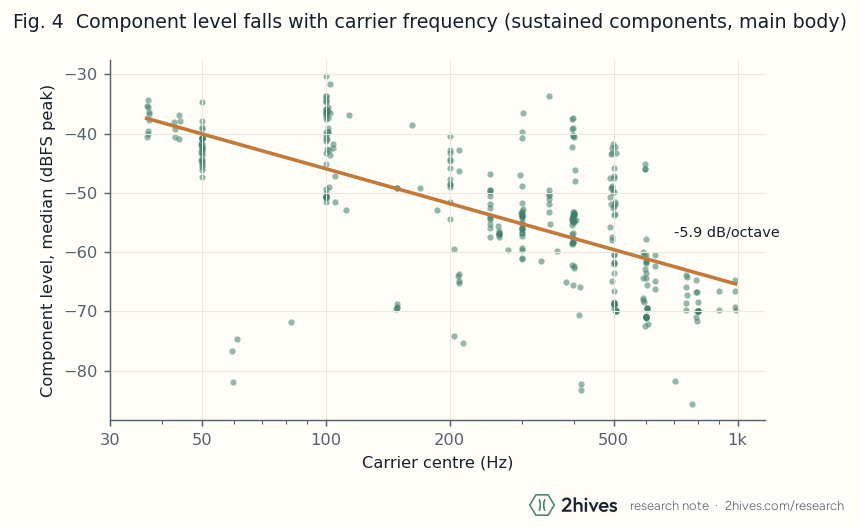
- Tone level changes by -3 dB per octave of carrier, so the higher tones sit quieter.
- 5 sessions end with a beta-range wake-up block.
- Noise bed: brown, independent in each ear. Its level and brightness move on a slow 10-second cycle.
Tuning and carriers
The Tuning setting in the editor re-pitches the carrier tones and never the beats.
- Standard: carriers from 120 to 592 Hz, as designed.
- A=432 Hz: every carrier 31.8 cents lower, from 117.8 to 581.2 Hz.
- Solfeggio: carriers snap to 174, 285, 396, 528, 639 Hz inside their own range; the lowest and highest carriers keep their pitch.
Tunings and tones are offered as sound to explore, with no promise of effects. Read what the research says about frequencies.
The method
The sessions use the layered binaural method described in our research note. We measured a reference set of guided programs and generate every bed from those statistics, never from a recording.
- Carrier–beat ordering: slow beats ride on low carriers and faster beats on higher ones, and each tone's level falls with carrier frequency (stacking and level).
- Each phase moves the stack to a new band and crossfades smoothly into it (beats by stage).
- A noise bed shaped to the measured spectrum keeps the tones soft and masks small sounds around you (noise).
- The voice sits about 12 dB above the bed, and gentle mastering leaves the stereo beats intact (how your audio is made).
Session by session
Future Self 1 · The Horizon Path · 30 min
| Phase | Minutes | Band | Beats (Hz) | Carriers (Hz) | Tone pairs | Noise (dBFS) |
|---|---|---|---|---|---|---|
| Arrive | 2.5 | alpha | 8, 10 | 185, 244 | 2 | -40 |
| Settle | 3 | alpha | 8, 10 | 124, 245, 485 | 3 | -40 |
| Descend | 3 | theta | 7, 7.5 | 124, 244, 364 | 3 | -40 |
| Journey | 8.9 | theta | 6, 6.25, 6.5, 10 | 123, 243, 363, 485 | 4 | -40 |
| Deep | 6 | theta | 6, 6.25, 6.5 | 123, 243, 363 | 3 | -40 |
| Return | 3 | theta | 7, 7.5, 10 | 124, 244, 485 | 3 | -40 |
| Rise | 1.5 | alpha | 10 | 245, 485 | 2 | -41 |
| Awake | 2.2 | beta | 15, 16, 40 | 328, 488, 612 | 3 | -41 |
Future Self 2 · Five Years On · 30 min
| Phase | Minutes | Band | Beats (Hz) | Carriers (Hz) | Tone pairs | Noise (dBFS) |
|---|---|---|---|---|---|---|
| Arrive | 2.5 | alpha | 8, 10 | 185, 244 | 2 | -40 |
| Settle | 3 | alpha | 8, 10 | 124, 245, 485 | 3 | -40 |
| Descend | 3 | theta | 6.5, 7 | 124, 243, 364 | 3 | -40 |
| Journey | 8.9 | theta | 5.5, 5.75, 6, 10 | 123, 243, 363, 485 | 4 | -40 |
| Deep | 6 | theta | 5.5, 5.75, 6 | 123, 243, 363 | 3 | -40 |
| Return | 3 | theta | 7, 10 | 124, 244, 485 | 3 | -40 |
| Rise | 1.5 | alpha | 10 | 245, 485 | 2 | -41 |
| Awake | 2.2 | beta | 15, 16, 40 | 328, 488, 612 | 3 | -41 |
Future Self 3 · Ten Years On · 30 min
| Phase | Minutes | Band | Beats (Hz) | Carriers (Hz) | Tone pairs | Noise (dBFS) |
|---|---|---|---|---|---|---|
| Arrive | 2.5 | alpha | 8, 10 | 185, 244 | 2 | -40 |
| Settle | 3 | alpha | 8, 10 | 124, 245, 485 | 3 | -40 |
| Descend | 3 | theta | 6, 6.5, 7 | 124, 243, 363 | 3 | -40 |
| Journey | 8.9 | theta | 5, 5.25, 5.5, 10 | 123, 242, 363, 485 | 4 | -40 |
| Deep | 6 | theta | 5, 5.25, 5.5 | 122, 243, 363 | 3 | -40 |
| Return | 3 | theta | 6.5, 7, 10 | 123, 244, 485 | 3 | -40 |
| Rise | 1.5 | alpha | 10 | 245, 485 | 2 | -41 |
| Awake | 2.2 | beta | 15, 16, 40 | 328, 488, 612 | 3 | -41 |
Future Self 4 · Twenty Years On · 30 min
| Phase | Minutes | Band | Beats (Hz) | Carriers (Hz) | Tone pairs | Noise (dBFS) |
|---|---|---|---|---|---|---|
| Arrive | 2.5 | alpha | 8, 10 | 185, 244 | 2 | -40 |
| Settle | 3 | alpha | 8, 10 | 124, 245, 485 | 3 | -40 |
| Descend | 3 | theta | 5.5, 6, 7 | 124, 243, 363 | 3 | -40 |
| Journey | 8.9 | theta | 4.5, 4.75, 5, 10 | 122, 242, 362, 485 | 4 | -40 |
| Deep | 6 | theta | 4.5, 4.75, 5 | 122, 242, 362 | 3 | -40 |
| Return | 3 | theta | 6, 7, 10 | 123, 244, 485 | 3 | -40 |
| Rise | 1.5 | alpha | 10 | 245, 485 | 2 | -41 |
| Awake | 2.2 | beta | 15, 16, 40 | 328, 488, 612 | 3 | -41 |
Future Self 5 · The Decision · 30 min
| Phase | Minutes | Band | Beats (Hz) | Carriers (Hz) | Tone pairs | Noise (dBFS) |
|---|---|---|---|---|---|---|
| Arrive | 2.5 | alpha | 8, 10 | 185, 244 | 2 | -40 |
| Settle | 3 | alpha | 8, 10 | 124, 245, 485 | 3 | -40 |
| Descend | 3 | theta | 5.25, 5.75, 7 | 124, 243, 363 | 3 | -40 |
| Journey | 8.9 | theta | 4.25, 4.5, 4.75, 10 | 122, 242, 362, 485 | 4 | -40 |
| Deep | 6 | theta | 4.25, 4.5, 4.75 | 122, 242, 362 | 3 | -40 |
| Return | 3 | theta | 5.75, 7, 10 | 123, 244, 485 | 3 | -40 |
| Rise | 1.5 | alpha | 10 | 245, 485 | 2 | -41 |
| Awake | 2.2 | beta | 15, 16, 40 | 328, 488, 612 | 3 | -41 |
What you'll practise
- Horizon Path — A path to the horizon with markers at five, ten and twenty years.
- The Meeting — Meeting an imagined future you, noticing them and asking for one piece of advice.
- One Decision — One choice, brought to all three future selves, ending in one small step.
Questions
What frequencies does Future Self use?
Beats from 4.25 to 40 Hz on carrier tones from 122 to 612 Hz, covering the theta, alpha, beta, gamma bands. Each phase layers up to 4 tone pairs over a soft brown noise bed.
Do I need headphones for Future Self?
Yes, stereo headphones. A binaural beat exists only when each ear hears its own tone; speakers mix the two tones in the air before they reach you.
How long are the sessions?
5 sessions of 30 minutes each at the default length. You can choose other lengths in the editor.
What does the research say about binaural beats?
Binaural beats are a real perception, created where the signals from both ears meet in the brainstem (Oster, 1973). Whether they entrain brainwaves is unclear: a 2023 systematic review found mixed results (Ingendoh et al., 2023). A 2019 meta-analysis found a medium overall effect on the outcomes it pooled (Garcia-Argibay et al., 2019). Relaxation, guidance and expectation also shape the experience.
Is Future Self a substitute for professional care?
No. 2hives courses are relaxation and meditation audio. Read the safety notes before you listen, and talk to a doctor first if you have epilepsy or a hearing condition.